


Science · Weather · Lesson 3 of 8
Clouds and how they form
Clouds are not bags of smoke. They are huge crowds of tiny water droplets or ice crystals, gathered where moist air has cooled.

I love flying near clouds — but I never fly through a thunderhead. Let's learn their names and how they form.
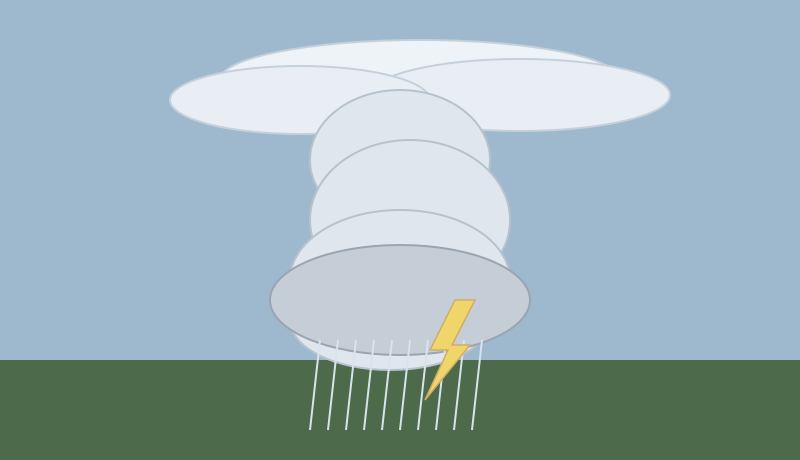




How a cloud is born
A cloud forms when moist air cools until some of its water vapor condenses onto tiny particles in the air — bits of dust, salt, or pollen called condensation nuclei. The droplets are so small that they can stay aloft, riding the air. From the ground a cloud looks like a solid object, but if you could walk into a gentle one, you would find wet air and very fine mist, not a wall. Clouds float because the droplets are light and because rising air often holds them up. When droplets join and grow heavy, they fall as rain or snow.
Families of clouds, by height and shape
Scientists group clouds by their shape and by the height of their bases. Cumulus clouds are heaped and puffy, often with flatter bottoms. Stratus clouds are layered, like a blanket. Cirrus clouds are high, thin, and wispy, made mostly of ice crystals. The word nimbus, or the prefix nimbo- or the suffix -nimbus, points to a rain-bearing cloud. So nimbostratus is a layered rain cloud, and cumulonimbus is a heaped, towering thundercloud. Clouds can also combine these ideas. Cirrostratus is a thin, high veil. Altocumulus and altostratus live in the middle storey of the sky. Stratocumulus is a lumpy low layer. Cirrocumulus is a high ripple of tiny puffs, sometimes called a mackerel sky.
What different clouds can hint
No cloud is a perfect promise of what will happen next, but many give honest hints. Small, scattered cumulus clouds often travel with fair weather. A thickening sheet of cirrostratus, sometimes with a halo around the sun or moon, can mean a warm front and steadier rain are coming. Nimbostratus brings widespread, lasting rain or snow. A towering cumulonimbus can bring thunderstorms, heavy rain, hail, and sometimes a tornado. Learning the names is not just a list to memorize — it is a way of reading the sky with more care.
Check your understanding
Five short questions on this lesson.