


Science · Weather · Lesson 7 of 8
Weather tools
A thermometer, a barometer, an anemometer, and a rain gauge turn the sky's hints into measurements you can write down.

You can be a weather observer at home. A few simple tools, used faithfully, teach you more than a single glance at the sky.
Thermometer and barometer
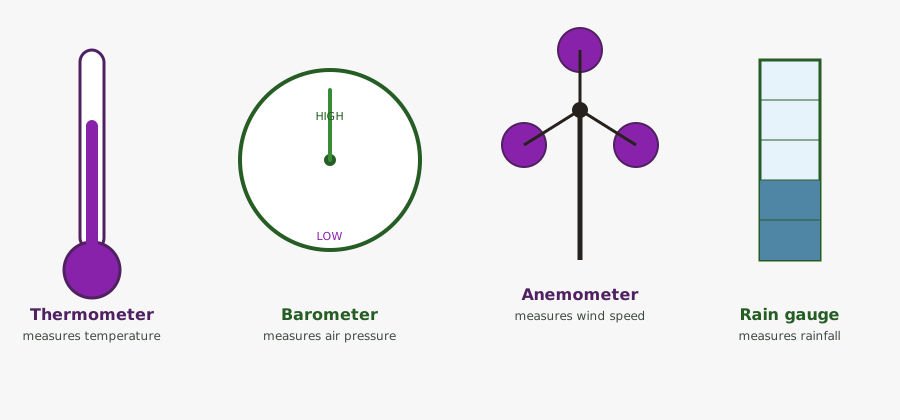
A thermometer measures temperature, the hotness or coldness of the air, usually in degrees Fahrenheit or Celsius. Keep it in the shade, not on a sunny wall, if you want the temperature of the air rather than the temperature of a hot surface. A barometer measures air pressure. When the pressure is rising, fairer weather often follows; when it is falling, unsettled weather is more likely. The barometer does not command the sky, but used with a look at the clouds, it is a valuable clue. The first regular weather records were kept with tools much like these.
Anemometer and rain gauge
An anemometer measures wind speed. A common kind has cups that spin in the wind; the faster they spin, the stronger the wind. Wind direction is often read from a weather vane, whose pointer faces into the oncoming wind. A rain gauge is a simple, careful cup: it catches precipitation and lets you read the depth, usually in inches or millimeters. Snow can be measured as the depth of the snowfall and, after melting, as its water equivalent. Empty the gauge after you record, or the next storm will add itself to the last.
Becoming a careful observer
The most important tool is a habit. Note the time, the temperature, the pressure if you have it, the wind, the clouds, and any precipitation. A weather journal, filled in for a month, will teach you the patterns of your own backyard — which way storms often come, how a halo around the moon sometimes precedes rain, how the air feels before a cold front. You can download a journal page from this course and start today. Official forecasts use satellites, radar, balloons, and computers, and they are a gift. Your own notes still matter. They train your attention.
Check your understanding
Five short questions on this lesson.