

Science · Weather · Lesson 2 of 8
The water cycle
The same water travels up as vapor, gathers in clouds, falls as rain or snow, and collects again — a circle with no true end.

The water in a puddle might once have been in a cloud, a river, or even a dinosaur's drink. Let's follow its path.
A circle, not a straight line
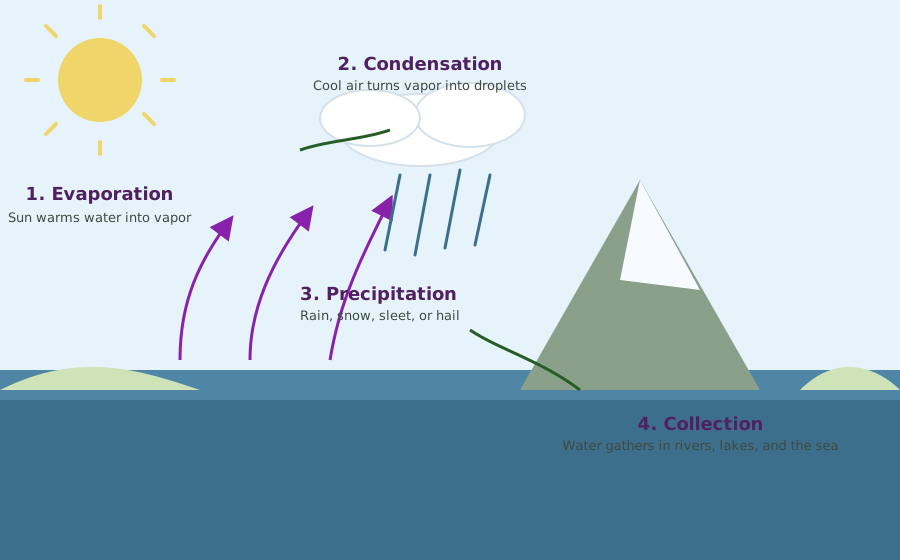
Earth's water is always on the move, but it is not used up. The water cycle is the path water takes as it changes form and place: from liquid to invisible vapor, to tiny droplets in a cloud, to rain or snow, and back into rivers, lakes, soil, plants, and the sea. The sun supplies the energy that lifts water into the air. Gravity brings it down again. The amount of water on Earth stays nearly the same; it just keeps changing costume.
Evaporation and transpiration
When the sun warms a lake, a puddle, or the ocean, some liquid water becomes water vapor and rises into the air. That is evaporation. You cannot see the vapor itself, though you can sometimes see steam, which is vapor mixed with tiny droplets. Plants take part too. Water that plants pull from the soil can leave through tiny openings in their leaves. That is transpiration. Together, evaporation and transpiration are sometimes called evapotranspiration — a long word for water going up.
Condensation, precipitation, and collection
As warm, moist air rises, it expands and cools. Cool air cannot hold as much vapor, so some of the vapor turns back into liquid droplets, or into ice crystals if it is cold enough. That is condensation, and it is how clouds are born. When droplets or crystals grow heavy enough, they fall as precipitation: rain, snow, sleet, or hail. The water then collects in streams, rivers, lakes, and oceans, soaks into the ground as groundwater, or is stored for a season as snow and ice. Then the sun begins the work again.
Check your understanding
Five short questions on this lesson.