


Science · Weather · Lesson 5 of 8
Weather systems
Highs and lows, thunderstorms, tornadoes, hurricanes, and blizzards are different ways the atmosphere organizes itself — some gentle, some fierce.

Not every storm is the same. Let's learn how a thunderstorm, a tornado, a hurricane, and a blizzard are built.
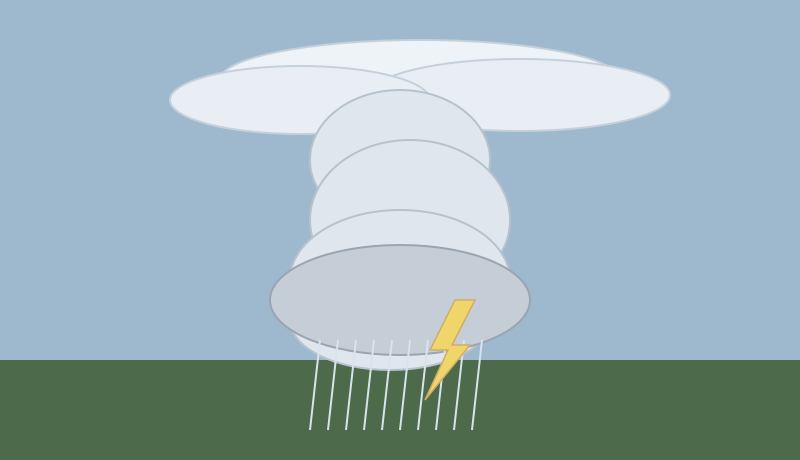
Thunderstorms
A thunderstorm needs warm, moist air that can rise quickly, and a way to lift that air — a cold front, a hot afternoon, or a mountain slope. As the air rises, a cumulonimbus cloud can grow tall. Water droplets and ice crystals move up and down inside the cloud and become electrically charged. A sudden discharge of that electricity is lightning. The lightning heats the air so quickly that the air expands with a crack and a rumble: thunder. A typical thunderstorm may also bring heavy rain, gusty wind, and sometimes hail. Most last less than an hour in any one place, but they deserve serious respect.
Tornadoes
A tornado is a violently rotating column of air that reaches from a thunderstorm to the ground. Not every thunderstorm makes one. Tornadoes are more likely when a strong, rotating thunderstorm, called a supercell, has wind that changes speed or direction with height — a condition called wind shear — along with warm, moist air near the ground and cooler air above. The funnel can be visible as a cone of cloud and debris. Tornadoes can be narrow or wide, brief or lasting, and they can be extremely dangerous. If a warning is issued, go to an interior room on the lowest floor, away from windows, and stay there until the danger has passed.
Hurricanes and blizzards
A hurricane is a large, organized tropical cyclone with very strong winds and heavy rain. It forms over warm ocean water, which feeds it energy. At the center is a calmer eye, surrounded by a ring of fierce thunderstorms called the eyewall. In the western Pacific the same kind of storm is often called a typhoon; in the Indian Ocean it may be called a cyclone. The names change with the region; the engine is similar. A blizzard is a different kind of trouble: a severe winter storm with strong winds, blowing or falling snow, and very low visibility, often with dangerous cold. You do not need mountains of new snow for a blizzard if the wind is lifting snow already on the ground. In every kind of severe storm, listening to local warnings and having a family plan matters more than any single fact.
Check your understanding
Five short questions on this lesson.